
This is the final exercise of Paper 1 and 2. It can be an article, a report or a review writing. We’ll look at articles here.
You will be given a topic (more like a question to ponder up on) on which you have to write your views and opinions. This can either be a two-sided article (for and against) or a one-sided article (just your opinion). It is up to you to decide.
The topics usually given for this exercise are easy enough that you can come up with points right there in the exam, but it is good if you read upon various issues from around the word (obesity, technological influences, environmental issues, animal welfare, teenager issues etc).
So here’s how to attempt this question:
- Before you start it is a good idea that you come up with a plan. Use the blank space below the question to make your plan, in pencil. In your plan write down the answers to these questions:
-
- The audience: this will be specified in the question (it is almost always a school magazine). So when you write, keep in mind that you need to write to that audience. Your language, tone and vocabulary should reflect this.
-
- Is my article going to be two-sided or one-sided? If you know a lot about the topic and can weigh up the pros and cons, then go for two-sided. If you’re not too knowledgeable about it, stick to one-sided.
-
- How do I introduce the topic? Start off by saying what the topic is and how important the topic is in today’s world. Why it is such a problem? Or is it a problem?
-
- What’s in the body? Write down three points. (If it’s two-sided write two pros and two cons). You will develop your body based on these points. A few points will be given in your question paper, and you can use those!
-
- How will I conclude the article? You need to sum up your points and give your final opinion (even if it’s two-sided, give your final opinion on the matter).
- Organise. By now, you’ve pretty much come up with the contents of your article. Now organise your points into paragraphs.
-
- One-sided Article:Paragraph 1: Introduction
-
-
- Paragraph 2: First point with justification (or counter-argument)
-
-
-
- Paragraph 3: Second point with justification (or counter-argument)
-
-
-
- Paragraph 4: Opposing point which you contradict (here, you state a point said by people who have a different opinion from yours and explain why they are wrong. This is called argument and counter-argument)
-
-
-
- Paragraph 5: Conclusion- summary, (solution?), repeat your opinion
-
-
- Two-sided Article:Paragraph 1: Introduction
-
-
- Paragraph 2: Advantages/’For’
-
-
-
- Paragraph 3: Disadvantages/’Against’
-
-
-
- Paragraph 4: Conclusion- Summary and final opinion
-
- Write. Use a variety of connecting words and argumentative phrases. Examples:
-
-
- Expressing opinions:I agree/ disagree with the above statement that
-
-
- In my opinion
-
-
-
- I believe that
-
-
-
- I am in favour of
-
-
-
- I am against the idea of
-
-
-
- It seems to me that
-
-
-
- I sympathize with
-
-
- Presenting and contrasting opinions:The main argument in favour/ against is
-
-
- It is often said that
-
-
-
- First of all I should like to consider
-
-
-
- Apart from that
-
-
-
- Even though
-
-
-
- Furthermore
-
-
-
- In addition
-
-
-
- Moreover
-
-
-
- Nevertheless
-
-
-
- And
-
-
-
- Or
-
-
-
- But
-
-
-
- Finally
-
-
-
- Lastly
-
-
-
- Despite the fact that/ In spite of
-
-
-
- On the other hand
-
-
-
- On the contrary
-
-
-
- Whereas
-
-
-
- What is more
-
-
-
- What matters most in this case is
-
-
-
- It is a fact that
-
-
-
- Besides
-
-
-
- After all
-
-
-
- There is no doubt that
-
-
- Reasoning:Because of
-
-
- As a result of
-
-
-
- Owing to
-
-
-
- Through
-
-
-
- Due to
-
-
-
- Consequently
-
-
-
- On account of
-
-
-
- Therefore
-
-
-
- Hence
-
-
- Concluding:To sum up
-
-
- To conclude
-
-
-
- It can be concluded that
-
-
-
- I believe that
-
-
-
- Thus, I am of the opinion that
-
-
- Argumentative verbs (use these instead of say/tell):
-
-
- Claim
-
-
-
- Assert
-
-
-
- Insist
-
-
-
- Argue
-
-
-
- Allege
-
-
-
- Suggest
-
-
-
- Point out
-
-
-
- Maintain
-
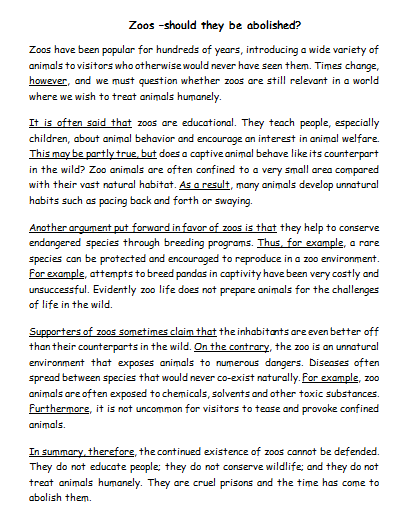
Here’s an example of a one-sided article. This is one-sided because, even though it weighs up both ‘for’ and ‘against’ points, in each paragraph it contradicts the ‘for’ points and alludes to the same conclusion that zoos should be abolished. This is called the argument/counter-argument format.
Tips
- Use your own points, words and phrases as far as possible. The more original your content is, the better.
- Give a suitable title
- Keep to the word limit 150-200 words. Exceeding a little over 200 is not a problem.
- Always have an introduction and conclusion
- Always organise your points into paragraphs. One para for each point (one-sided) or all advantages in one para and disadvantages in another para (two-sided) is the ideal format.
- A final opinion has to be given.
- Punctuation, spelling and grammar is very important. Check your writing once you’re done.
Time Management
For the core paper 1 take 20 minutes for this exercise
For the extended paper 2, 30 minutes should suffice to answer this question. Spend 10 minutes to come up with a plan, 15 minutes to organise and write your article. Use the 5 minutes left to read over your article, make changes and correct spelling, grammar and punctuation errors.
Notes submitted by Lintha
Click here to go to the next topic
Click here to go to the previous topic
Click here to go back to the English menu
 IGCSE AID
Hi Sarah
I hope you are doing great!
Thank you for sharing such informative notes. By the way Sarah could you kindly recommend an English Novel to read to have good Vocabulary.
Actually I really need to increase my vocabulary as I am lacking in it.
Thank You!
LikeLike
Hi Noor,
Sorry for the late reply, I unfortunately didn’t see your comment until now!
I would honestly recommend any book that you find interesting – reading should be fun, and you’ll actually absorb more of the words and pick up more phrases if you enjoy what you’re reading.
Some recommendations:
Some of my favourite classics include –
– Pride and Prejudice by Jane Austen
– Jane Eyre by Charlotte Bronte
Childhood and teenage favourites include –
– the Harry Potter series by J K Rowling
– the Percy Jackson series by Rick Riordan
Current favourites include –
– When Breath Becomes Air by Paul Kalanithi
– A Thousand Splendid Suns by Khaled Hosseini
But honestly, read anything you enjoy – just makes sure they’re books published by a proper publishing company. Avoid platforms like Wattpad or self-published books as the grammar and use of vocabulary in these books can be poor, and you may unintentionally pick up incorrect usages.
LikeLike
hi,
this really was helpful, I would like to ask that if we can write a one-sided or two-sided article for IGCSE seeing which one we are comfortable with.
Also, do you know any sites where we can get our practised articles checked and marked?
Thank you
LikeLike
If possible, I would way out both sides in your article before coming to a conclusion that you can agree with, as this shows that you can use language supporting the for as well as the against argument. However, if you think that you will be able to write a one-sided article better than a two-sided article, it is better to stick to one side!
I’m afraid I don’t know where you can get your practice articles checked and marked, but would recommend asking your teacher to review your articles. If your teacher is not willing, you could discuss the article with your friends or ask an English tutor to help!
I hope this helps,
Sarah
LikeLike
Can You all make some notes for E-mail writing too, please?
LikeLike
Hi Haroon,
The reason we haven’t made separate notes for email writing is because email writing follows the same rules as letter writing.
I hope this helps!
LikeLike
Thank you so much it helped me alot and gave me information
I appreciate it .
LikeLiked by 1 person
We’re really glad you found the notes helpful!
We hope you ace your exams ❤
LikeLike
This has really helped me alot thanks so much.
LikeLike
Welcome!
LikeLike
i would like to kniw how to exactly improve my vocabulary, because ones i get to know a new word itt doesnt work out for me to use it in a sentence
LikeLike
Hi Khalid,
My top tips to you would be:
1. Always carry a small dictionary with you, so you can look up definitions of new words as you find them.
2. Read English books (this is really good for picking up good spelling and grammar, as well as understanding the proper usage of words)
3. Watch English movies (this is good for picking up slang, phrases, expressions, learning how natives talk and working on your listening skills)
4. Make a friend who is a native English speaker and practise with them – this could be an online friendship, a pen pal, or an in-person friendship
LikeLike
It’s really worthy for learners as well as facilitators. Can we teach the same methods for report writing too, with slight differences?
LikeLike
I wanted to ask if the newspaper article is formal or informal. Also if the school magazine articles are formal or informal?
LikeLike
Hi Zainab,
Sorry for the delay in getting back to you!
Deciding if your newspaper article is formal or informal depends on your audience and the topic of the article! If your article is aimed at a more formal audience/ newspaper, then your writing should be formal. For example, if your target audience is known to be a more sombre, formal group of people, writing in a formal style would cater better to their tastes. Alternatively, if you were writing to people your own age or younger than you, they may enjoy reading a more informally written article – however, avoid using slang and the kind of abbreviations used over SMS or social media (i.e. u instead of you, ttyl, brb, lmao, lol, etc.)
No matter which audience you are talking to, however, if your topic is serious e.g. war, famine, natural disasters, mental health, etc. you should always write formally – writing informally about serious topics could be considered very disrespectful.
There are some topics where the decision to write formally or informally is totally up to you! Sometimes you want your writing style to sound more fun and casual when talking about a particular topic, sometimes you want it to sound more reflective. An example of a topic that you could write formally OR informally about is love!
I hope this helps!
LikeLike
This is great work. I’ve learned a lot and I believe to see more .👍
LikeLike
Thank you so much. We are trying our best to update it as soon as possible.
LikeLike
But how do you end an article
LikeLike
Hello!
Summarise the points you have made in a two or three sentence. If you have an opinion, stress on it. Check the example given in the article above too!
LikeLike
thank you ! you impressed me so much reading it
LikeLike
Thank you so much
LikeLike
very accurate and helpful as well
LikeLike
Thank you for the notes, I greatly appreciate them. If I understand correctly an article is mostly about your opinions.
LikeLike
Really thank u it helped me so much through my last exam
LikeLike
Thank you very much! I will appear for IGCSE this MAY/JUNE
LikeLike
This site is designed as a communication guide for everyday speakers of English language, most especially, the ESL speakers. To Africans and all learners of English language, I say congratulations. More power to your elbow, admin….
LikeLiked by 1 person
How do you come up with ideas for formal writing?
LikeLike
is it wrong if i write subheading between each paragraph??
LikeLike
If it’s an article, that’s okay.
But avoid having too many subheadings (three is generally a good number, taking into account the 250 word limit)
LikeLike
No. it is not wrong if you write subheadings in between the paragraphs.
LikeLike
is there any notes for how to write a report or a review for the new syllabus 2019?
for an article, when the question says ” giving your views ” is it one-sided or two-sided?
LikeLike
Hi! We will put up the report writing notes by the end of the month as we’re currently updating notes to match the 2019 syllabus. Stay tuned! 😉
As for the second query, a question will usually ask you to ‘give your views’ in a two-sided argument (as a conclusion). A one-sides article is essentially only your views right?
Hope that clears up the doubt.
LikeLike
I’m not sure I understand, if a question says “ Write an article to your school magazine, giving your views”, does that mean I have to write a two-sided article or a one-sided article?
Also, I’m a self-studying student so it’s quite hard for me to study english as the summary, informal and formal writting requires someone to actually check them. Do you know any websites where I can find free tutors?
LikeLike
In that case, a one-sided article will do.
I’m afraid I don’t know about free online tutoring. Refer to different websites for more tips. Keep working out different papers and check your answers against their marking schemes, making sure you’ve stuck to the points I outlined above. Summary writing can be a pain in the neck and so practice is key.
LikeLike
Try using ProWritingAid.com and VirtualWritingTutor.com
LikeLike
I enjoyed reading this and also helped me in my exam out of 30 I got 28 and I was really happy thank you for making this happen
LikeLike
Congrats!! It’s great to hear that what we’re doing is actually helping others!!
LikeLike
Very helpful to all students!
Great job.👍
LikeLike
I think this clearly explains the rules of the article writing. I can easily understand theough those points which helps me figure out to easily write an article. Thank you so much.
LikeLike
Thank you for your kind comment!
We’re really happy that we’ve been of help 🙂
Good luck with your exams!
LikeLike